Tag: Online Monitoring

Ensuring resilience: Navigating transformer risks through advanced monitoring and IoT implementation

Embracing innovation in transformer management

Critical infrastructure management has leapt forward in an era dominated by technological advancement – and transformers are no exception. Gone are the days of relying solely on reactive maintenance, as integrating risk assessments, online monitoring, and the Internet of Things (IoT) promises a new dawn for transformer management. As we delve into the intricate world of transformers, we uncover the pivotal importance of tracking asset and condition risk, shedding light on achieving the elusive goal of 100% uptime.

I. The dual frontier: Asset risk and condition risk

Navigating the terrain of transformer management requires addressing two distinct yet interconnected facets: asset risk and condition risk.

Asset risk

Transformers represent substantial investments in any power infrastructure. Ensuring their longevity and optimal performance is paramount. Asset risk encompasses the probability of:

  • a safety incident occurring (if power is lost for more than 24 hours)
  • associated financial loss
  • environmental risk
  • contingency design (N minus 1 contingency and alternative back feed options)
  • strategic spare unit availability
  • repair capability and time frame
  • a transformer’s lifespan, considering age, design, and maintainability factors.

In this context, asset risk refers to the potential financial jeopardy from the loss of power to critical plant and is tied to the entire lifecycle of a transformer. This evaluation considers the transformer’s age, design intricacies, substation design and network interconnectivity. Practical asset risk assessment involves meticulously analysing historical data to discern network performance patterns or susceptibility to faults affecting the transformer and the equipment it supplies. In essence, it is the examination of the unavailability of that power source and the consequences of the absence of the power source.

Condition risk

Condition risk focuses on the internal health of transformers in the short- medium- and long-term. Oil-filled transformers are very forgiving and can operate under severe neglect. Neglected and often overlooked maintenance practices lead to costly breakdowns and lengthy service interruptions or repairs that require the transformer to be removed from service and shipped to a repair facility. Frequently, the shipping cost alone is very costly. It is when the transformer has been neglected that unexpected failures occur. These instances can lead to dire consequences, such as fires and the destruction of other equipment!

In the operation of these transformers, some condition parameters take many years to manifest or become apparent. Some take several months to change, and others mere minutes or seconds to occur. The latter set of condition parameters are the parameters every transformer operator or owner needs to monitor more intensely. Traditionally, a transformer’s “lifeblood” (aka oil or insulating fluid) is used to detect these condition changes.

Focusing on the more short-term condition is the breakdown of the fluid into gases that can be extracted from a transformer’s fluid body and chemically analysed. These gases can show several other conditions with different interpretation tools (eg Duval triangle, Duval pentagram, gas ratios). These parameters are often used as a gauge for the internal condition of the transformer. However, a thermometer only tells one what the temperature is and, in essence, cannot tell what the illness is. The use of computer databases can assist in extracting the correct data and forming a picture of the transformer’s health.

Considering the above, it is necessary to understand that there is a process of acquiring the data from the analysis. This process is often flawed and takes up to two months to obtain.

Enter the realm of online monitoring – an innovation that is pivotal in transformer management. By deploying online devices such as online DGA (dissolved gas analysis), dielectric, bushing and tap-changer monitors and harnessing the power of data analytics, online monitoring unveils a faster cycle into the transformer’s inner workings. For instance, a sudden spike in the gases beyond established thresholds could indicate a partial discharge, arcing or overheating issues, or a dip in oil quality might hint at an element of neglect and have a long-term impact on insulation degradation. From a bushing monitoring aspect, a shift in the tan delta measurements could show that a bushing is about to fail. A tap changer monitor can highlight added stress on the on-load switching device and cause premature failure. Additionally, oil quality irregularities could point towards loss of insulation capability and longer-term damage to the paper insulation, impairing the transformer’s ability to withstand the network variations and through fault instances. The value of this approach lies in its proactive nature.

Detecting these anomalies at their developing stage empowers utilities to initiate targeted interventions, preventing the domino effect of catastrophic failures and fortifying the overall robustness of the system against unexpected adversities. Higher instances of network disturbances such as cable theft, loadshedding, short circuits and overloading all affect the transformer’s reliability.

II. The digital vanguard: Online monitoring and IoT implementation

Online monitoring

Online devices strategically placed within a power delivery system network relay vital data to central control centres, where advanced algorithms decipher the information, enabling better predictive maintenance and swifter response to deviations from the norm. This intime vigilance transforms risk management from a guessing game into an informative science and resilient supply network.

These online devices meticulously collect a wealth of critical data, ranging from moisture-in-oil and temperature variations to dissolved gas composition nuances and bushing condition intricacies. This wealth of information embarks on a swift and seamless journey from devices to cloud-based applications to dashboards. It has algorithms to decipher the incoming data, unveiling patterns hidden from the naked eye. Enabling enhanced engineering decisions to safeguard the operations under normal and adverse operating conditions when needed, thus delivering the best short- and long-term performance.

Let’s step into a real-world scenario within a plant where the delivery of electrical power is vital. A transformer monitored by its intricate set of devices is available and able to supply the demand needed to ensure the plant delivers. On a typical busy day, soaring electricity demand prompts devices to detect and flag abnormal strain on components, signalling a potential power failure. Swiftly, crucial data is sent to a cloud-based dashboard, where advanced algorithms promptly identify an anomaly and track development. Production is critical, and power loss to the plant would be detrimental to the output of the plant. The proactive response isn’t just immediate; it’s part of predictive maintenance, leveraging data mining of historical and intime data to anticipate issues. Having both the network, asset and condition risk at hand enhances the ability to shift power flow from one network to another or an alternative supply.

What was once a guessing game, where maintenance decisions were based on a mix of historical practices and intuition, has now transmuted into an engineered solution. With its synergy of monitors, data analytics, and predictive algorithms, online monitoring can breathe life into proactive risk management.

Holistically, the risk model and the data associated with the risk data assist in forming a picture of where to spend the maintenance budget wisely, thus getting the best reliability from the power plant assets employed. Ultimately getting both performance when needed and return on investment optimised.

IoT Implementation

Before venturing into an extensive solution, it is best to consider the transformer’s network and the equipment it supplies power to. Much of the decision will be based on the importance of the equipment or processes provided by that transformer. As an example, consider a transformer that supplies power to a furnace. If the power transformer feeding that furnace were to stop functioning, the processes reliant on that hot metal would be without material to produce the end product. Again, in a different context, if the transformer supplied power to 200,000 households or businesses, those households and businesses would cease to function normally, plus the associated loss of revenue. Generally, the operation of the transformer in its environment and supplied load (typically the processes or customers) needs to be the focus of the asset risk. Setting up the correct asset risk evaluation is invaluable in understanding which asset needs to be monitored closely and more frequently.

Once the asset risk is determined, the condition risk can be used as a final step in the process. Taking the assets with the highest asset risk and using the condition risk to tweak the list to indicate which assets deserve closer scrutiny and enhanced monitoring. The asset highlighted in the analysis would be the best candidate to apply the IoT technology.

With the appropriate monitors, these transformers can provide reliable data that can be sent to the decision-making engineers, sharing intricate insights about the transformer’s health. For example, a transformer detects a surge in demand as factories ramp up production during the day. This information is published to a dashboard, allowing Operations to proceed with the comfort of knowing the power delivery system is stable and they can see the production run to its completion.

III. Pinnacle of reliability

The pursuit of perfection

The quest for 100% uptime may sound utopian. However, with IoT implementation, utilities can proactively address potential issues before they snowball into crises by having the details of network- and asset risk combined with sound condition data, allowing the system to operate at its peak. Predictive maintenance, guided by data-driven insights, minimises downtime and maximises efficiency.

Synergy in action

The synergy between asset risk evaluation and condition risk monitoring is the cornerstone of continuous power. As plant owners refine their risk assessment strategies, they align maintenance schedules with intime condition updates, ensuring that transformers are optimised for performance throughout their lifecycle.

Illuminating the future of transformer management

The combined force of network risk assessments, online monitoring, and IoT implementation to communicate the data is revolutionising transformer management. The importance of tracking assets and their condition risks cannot be overstated. The amalgamation of these cutting-edge technologies enables transformer owners to proactively safeguard transformers, minimising disruptions and inching closer to the coveted 100% uptime.

To read more about our transformer monitoring services, click here.
 

When transformer failure could set you back R1.4 million an hour – a motivation for online condition monitoring dissolved gas analysis

In the mining industry, the numbers are big. In monetary terms, the consequences of failure on critical assets can quickly run into the millions. Conversely, the value-add of effective online gas analysis monitoring on transformers will have a positive impact and improve the return on investment of critical assets.

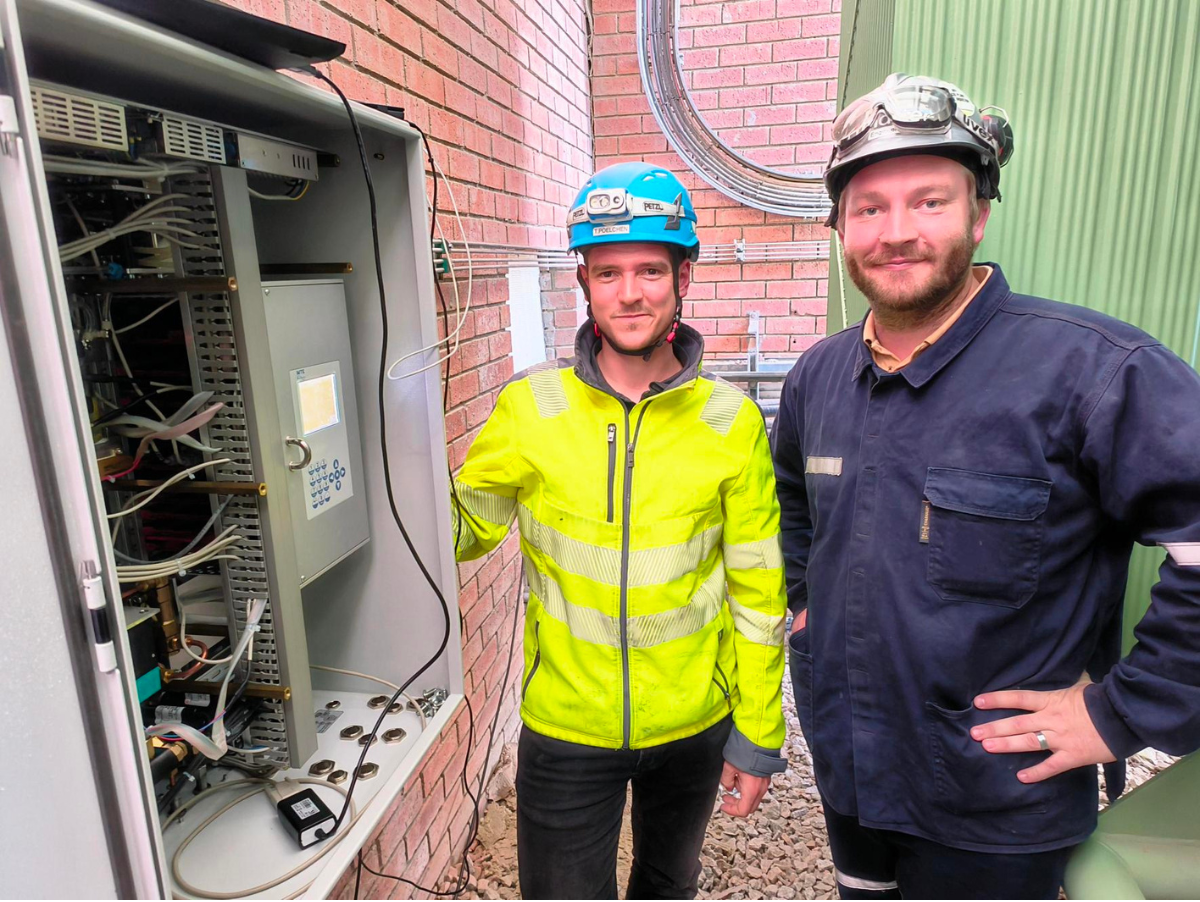
We recently completed the installation of the first single DGA (dissolved gas analysis) unit that monitors three transformer tanks at a client in the mining sector – a great milestone for Martec and South Africa, with this being the first installation of MTE’s Hydrocal H1008-3 DGA monitor. In this article, we look at the importance of transformer monitoring and the role and benefit of online DGA.

Comparing offline periodic and online continuous conditioning monitoring DGA

Traditionally a routine oil sample would be drawn and sent to an analysis laboratory for chemical analysis. This process can take up to a month to complete to have results that can be analysed. These samples are normally done annually; thus, there is only one set of data per year to determine the health status of a transformer. One must ask whether this data is enough to diagnose a pending problem. In essence, the answer is no.

Adding to the above, the manual sampling for DGA, a typically short-term health parameter, is often flawed. It takes a trained sampler to follow each step of the tedious process precisely and to take a representative sample using the correct container before taking it to a laboratory that is competent to do the analysis. The diagnosis is only as good as the sample taken.

In this instance, the client would lose approximately R1.4 million an hour if any of the transformers failed, and reliability with an online DGA monitor was paramount.

With online monitoring, the sample is reliably taken, analysed, and results are made available in a comparatively short amount of time (typically down to one or two hours, depending on the unit deployed and the setup of the online unit).

Can you ever have too much data?

When it comes to transformers, the short answer is no. With a DGA online monitor there is far more data to analyse through trends allowing us to identify a developing problem on a transformer. DGA is the best short-term solution for transformer condition monitoring in that other parameters can take months to develop, but DGA can occur in seconds, minutes, hours, or days. From the data derived from the unit, better decisions can be made on the unit’s health, especially when the risk of failure has catastrophic consequences.

Condition monitoring: value

In this case, the MTE Hydrocal unit (H1008-3) installed measures seven of the gases and moisture in the transformer; thus, with this type of unit it is possible to use the data for all of the values that are most desirous in condition monitoring:

  • Value 1 | Detection – a measured parameter has been exceeded
  • Value 2 | Monitoring – a trend can be produced to determine the rate at which the parameter is rising
  • Value 3 | Diagnostic – a combination of the parameters is used to predict a condition or fault that is occurring

All three values allow the Engineering and Maintenance teams time to plan and safely remove the unit from service for inspection and repair.

Transformer fleet risk analysis

Before applying online monitoring, conducting a transformer fleet risk analysis is best to determine which units are suitable for online monitoring. There are numerous criteria that need to be taken into consideration, and the use of the current sample results data to determine the current health status of the units within the fleet. By conducting transformer fleet risk analysis, organisations can make informed decisions about maintenance strategies, investments, and resource allocation to optimise the reliability and performance of their transformer fleet while minimising potential risks and associated costs.

Read more about our transformer monitoring service here.

The role of condition monitoring in optimising performance and safety in the mining sector

Mining reserves in South Africa are vast. According to statistics from the South African Department of Mineral Resources and the US Geological Survey our ore reserves amount to a value of more than US$2.5 trillion [1]. Conversely the industry is in crisis – why? Costs have become prohibitive, primarily due to years of lack of development in R&D, causing the industry to reduce its international competitiveness and no longer be an innovator on the forefront of new industrialisation opportunities.

Safety also plays a role in this arena. Although the number of fatal injuries has reduced by limiting reactive or unplanned maintenance, and further decreasing the likelihood of safety hazards, 58 deaths still occurred in 2020 [2].

Let us unpack how effective condition monitoring can work towards ameliorating this somewhat dire situation.

Mining in particular is fraught with unreliability due to mechanical haulage with extensive wear on equipment, and the best way to improve the reliability of a mine is with effective condition monitoring. Condition monitoring more than any other maintenance tactic can optimise your maintenance strategy whether you take an online, offline or intime condition monitoring approach.

With mining in particular the scale of economy in downtime is huge – moving the ore from the pit to the crushers to the end product – if any one of those stages breaks down the resulting financial loss is vast. For example, if a furnace transformer at a mine is off for one day losses can be calculated at up to R2.5M per day.

In addition, the synergistic roles of condition monitoring and safety in the mining sector cannot be underestimated. Condition monitoring consultant Tom Dalton says: “Safety often drives condition monitoring – human life or limbs are not replaceable. The condition of plant can have far reaching consequences in terms of safety. Consider the scenario at a deep mine hauling up to 30 people in the cage. Not only is it crucial to have condition monitoring technology on the cable to ensure it is within serviceable limits, we also need to consider the hidden reliability risks – if the cable should snap and the brakes (a hidden failure) failed, the results could be catastrophic. Thus, we can see that condition monitoring in our mining sector needs to consider multiple systems need to ensure optimal safety.”

Let us now consider the condition monitoring technologies which can be put in place with relative ease of implementation to improve both safety and ROI.

One of the original and stalwart pillars of condition monitoring is vibration analysis. This is a simple yet effective way to detect faulty components through placing accelerometers in strategic positions on the asset to be analysed to measure the vibration of the system. Vibration analysis utilises displacement, velocity and acceleration time waveforms (TWF), or the fast fourier transform (FFT) of the TWF to accurately detect faulty components.

“People don’t understand how easy these are to implement.” – Tom Dalton, Condition Monitoring Consultant

Another technology which should be considered on assets where early failure detection is especially important, is that of ultrasonic analysis. This technology can be used to detect sound abnormalities in electrical systems (eg corona, tracking, arcing); mechanical systems (eg drive belts, couplings, bearings) and tightness integrity (eg marine, chemical, medical).

Condition monitoring allows us to detect potential failures across all systems well in advance, allowing for proper planning, thereby improving the reliability of a mine and improving safety for the workforce. Simply put – condition monitoring allows us to increase uptime and decrease downtime.

Condition-based maintenance is applied when the deterioration in asset health or performance is detectable, or there is adequate warning time to react. (PF interval is large enough, HSSE issues are addressed and it is cost-effective).

Condition monitoring provides an accurate asset health diagnosis, which leads to preventive actions being taken as soon as potential failure is detected.

There is no equivalent to the P-F curve and for this reason performance is often overlooked. The consequences of unacceptable performance over the long term can be more costly than functional failure, which is quickly rectified.

Whilst these technologies can be readily implemented, there are hurdles to overcome. In this industry one of the biggest obstacles which we face today is the lack of training. Condition monitoring consultant Tom Dalton asserts this with the statement that: “There is lack of knowledge – people don’t understand the technology or they feel the technology is too expensive. Avoidance of proper succession planning also plays a role where the technology knowledge lies with only one person in the organisation. Organisations need to ensure that sufficient resources are trained in the technology.”

A further observance is that an organisation may have implemented the appropriate condition monitoring technologies, but fail to react on the information it provides. Essentially, it all comes down to trained and skilled resources implementing effective of condition monitoring in the system.

With all of these factors to consider – how do we move to the forefront of industry, ensure workforce safety and from a global standpoint, remain competitive?

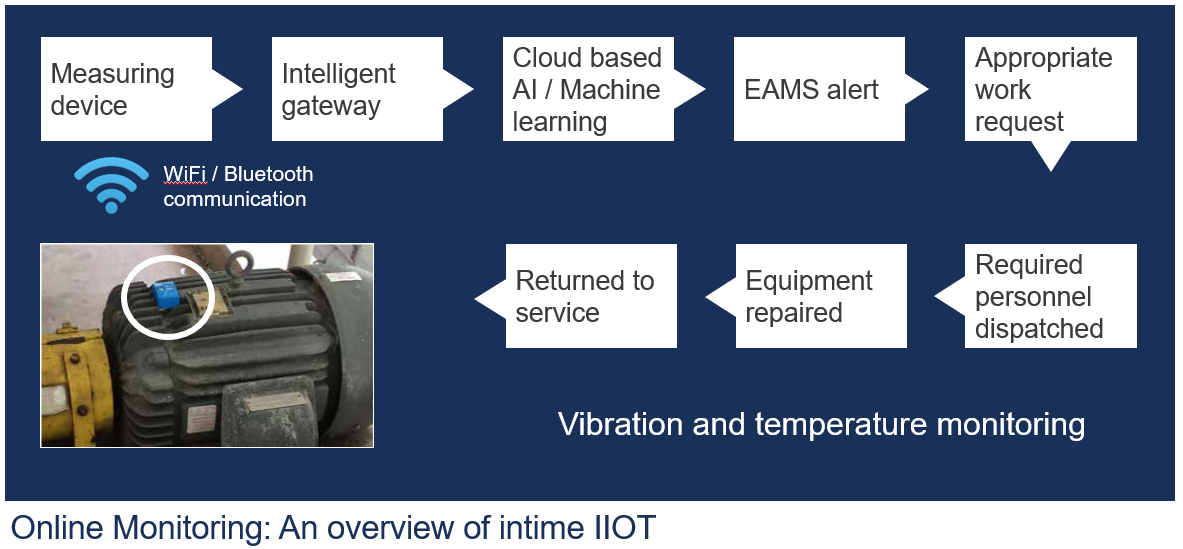
The advent of IIoT is upon us and to remain relevant in this arena we need to consider migrating our condition monitoring technologies to being intime, to remain relevant in this highly competitive global market. We cannot underestimate and consider the impact of what intime condition monitoring can bring to the ROI of our plant, as well as improved workforce efficiency and safety.

Online Monitoring: AN overview of intime IIoT

“We have to look at the optimal state we want our plant to be in – you need to determine your plant’s strategic path,” says conditioning monitoring consultant Tom Dalton. “Our reliability engineers are best equipped to determine the most cost-effective savings – yes – some may take years to realise – but we need to consider the that condition monitoring today is about extracting value, the role of technology and the integration with asset management. They are key to a sustainable benefit for the ROI of your plant and your workforce safety. These are the factors we need to consider in condition monitoring today.”

Statistics referenced/cited in the article
[1] The South African mining sector – Wits University
[2] South Africa: Mining industry fatalities 2020 | Statista

On-line monitoring of HV substation equipment: Myths and truths

Brian D. Sparling, Senior Member of IEEE, and Regional Manager with Dynamic Ratings Inc. 

The challenges facing substation owners and operators for the past years are unrelenting and are summed up in one sentence: “Reduce operating costs, enhance the availability of the generating and transmission equipment, and improve the supply of power and service to the customer base.” All this, in an environment where the available resources are inexorably decreasing and the pressure from the shareholders and the competition mount steadily. Critical oil-filled electrical equipment, such as transformers, shunt reactors, current transformers, circuit breakers and bushings, are key elements of an electrical power system. The reliable and continued performance is the key to profitable generation and transmission of power. The early detection of incipient faults in these assets can create economic benefits that have a measurable impact on the results required to meet these formidable challenges.

Thus continuous on-line monitoring Intelligent Electronic Devices (IEDs) have become commonplace and, with improvements in sensor technology and with built-in intelligence, have demonstrated their ability to meet the challenges. However, there are still some myths and misunderstandings surrounding the application of and benefits to be gained with these devices. These need to be brought out and discussed. During my twenty-plus years in this field, there persist what I call myths surrounding the use and at times misuse of these IEDs. In this article, I will try to bring out the most frequent of these myths.

Myth: If I use these IEDs, it will prevent the failure of my transformer or circuit breaker.

False
The truth is, if a piece of equipment is on its way to a failure, and nothing is in place to advise the owner of its imminent failure, then it will fail. There are of course protection devices (so-called transformer protection relays, etc.) to advise the owner of its failure (or failure to perform its function). These devices do nothing to protect or save the equipment. Their sole purpose is to remove that piece of equipment as quickly as possible from the system to avoid system problems. In other words, they are system protection relays and are not designed to protect the transformer.

A properly selected and applied monitoring IED is there to provide the early warning of a developing fault within the equipment. The warning to the owner is there to initiate some investigation and corrective action. One of the primary reasons for the use of the IED(s) is to reduce the risk of unexpected failure, not to stop a failure from occurring.
Another truth: These IEDs can and do provide early warning of symptoms of a potential defect, but the transformer failed anyway, occasionally catastrophically. This has happened more than once. The primary reason is that the system was not connected to an alarm annunciator, or into an RTU, because the job (installation and commissioning) was, in my words, NOT completed. By NOT completed I mean that no means of communications were connected to (at a minimum) the relay alarm outputs, or via Serial or Ethernet communications networks to some device to pass on the alarms. Speaking of alarms, another failing to complete the job item is training of the operators, or others to be able to respond to the alarm. These systems will deliver “new types” of alarms that some operators have never been trained in, i.e. how to respond to alarms they have not seen before. Some deeper understanding of the alarm and the consequences of ignoring these alarms must be communicated to those who are responsible.

Table 1 presents an example of such an alarm statement, with a recommendation of next steps, to ultimately making an informed decision. These two are only the beginning; a listing of ALL possible alarms needs to be defined and operators trained.

Myth: If I use these IEDs on my equipment, they will advise me of ANY defect or malfunction of that equipment.

False
The truth is, primary equipment has many failure modes and a good many are VISUAL. When performing an FMEA (failure modes and effect analysis), and all possible failure modes are listed, then lined up with technology and/or methods that can be used to detect the symptoms of those failure conditions, I have found that between 30 % and 40 % of failure modes are VISUAL in nature.

Table 1. Example of alarm statements, with recommendations of next steps necessary for making informed decisions

   Alarm condition    Diagnostic    Prognostic    Recommendations
  •  Top oil temperature Alarm 1st  Level; and loading above maximum nominal rating.
  • The transformer oil is currently operating at a temperature above the first level of alarm setting.
  • This is apparently caused by the high load currently applied.
  • If this condition is maintained for several weeks, it could result in accelerated oil ageing.
  • Make sure the cooling system is fully operational.
  • Check ambient temperature
  • Evaluate acceptable load with regard to ambient temperature.
  • Consider reducing load.
  • HI DGA Alarm 1st Level
The DGA Monitor HI relay has been triggered because of one of the following:

  • High alarm settings have been exceeded: gas level, hourly trend or daily trend.
  • A “DGA” alarm is indicative of a fault condition developing in the transformer. If unattended, the transformer may develop a “Gas High-High” alarm.
  • Take an oil sample for full DGA analysis to confirm alarm condition.
  • Check the history of DGA IED trending.
  • Search for correlation of DGA IED history against loading and OLTC tap changer position.

Continue reading

Future of substation monitoring: It is not just the software

Brian D. Sparling, Senior Member of IEEE, and Regional Manager with Dynamic Ratings Inc. 

The future of online monitoring of high voltage substation equipment is closely linked to enterprise asset management systems provided that proper measures are implemented for the EAM system to deliver the expected results. Those measures include trained personnel, detailed knowledge of one’s assets, technically and economically feasible maintenance process, the flow of information to personnel, and collaboration with a company that can provide the monitoring system as well as the expertise in its implementation. Monitoring and diagnostics are now part of the business process which contributes to a reduction in forced outages and a more secure and reliable system.

Introduction

I am an avid follower of various LinkedIn groups and have recently read with interest items from two diverse and separate groups, which, on the surface, appeared to have no connection with each other. One was from the Transformer Condition Monitoring group, asking the question “Is there a future for transformer monitoring and why/why not?”. I would refer the questioner to review my article published a year ago in Transformers Magazine for some of the answers.

Another item from the IAM Discussion group highlighted the author’s enterprise asset management predictions for 2018. I did touch on this topic of asset management in my previous article, yet found that this item provided more focus on why many of the systems fail to deliver on what the asset owner thought they had signed up for. In my mind, these two are connected. The future of substation monitoring is closely linked to the latest in buzz words or phrases such as Internet of Things (IoT ) and EAM. Full disclosure: I work for a company that engineers, produces, and provides engineering services to those companies owning and operating HV assets on the power system. We also produce asset analytics for those very same assets monitored.

Terrence O’Hanlon, CEO at Reliabilityweb.com, has noted what his company sees daily, not necessarily with electrical energy companies, but their observations carry over:

  • a reminder that 80 % of the people who care about EAM and read this cannot access their work orders on a mobile device,
  • only 40 % of the organisations they studied have an actionable EAM based asset registry,
  • only 30 % of the organisations they studied have accurate and up to date asset criticality rankings.

Mr. O’Hanlon in his post predicts the following:

  1. Without an engaged and empowered workforce, EAM will still fail to create a positive return on investment.
  2. Without knowing what assets, you have, EAM will still fail to create a positive return on investment.
  3. Without a technically and economically feasible maintenance process (such as CBM), EAM will still fail to create a positive return on investment – no matter how much IoT you implement.
  4. Without adequate and ongoing EAM training, EAM will still fail to create a positive return on investment.
  5. Without active executive sponsorship, EAM will still fail to create a positive return on investment.

I will add another prediction: A failure to communicate – unique to utilities with remote substations, some located in geographically difficult to reach areas, either in terms of distance (hundreds of kilometers away from operational centres), or in times of extreme or even normal weather conditions (winter), which makes getting to the sites at times hazardous. Many who buy and install monitoring systems have not implemented the items necessary to take advantage of the data and information available for an EAM system. This can lead them to failure to create a positive return on investment (ROI).

Communications

Communication is extremely important and is a requirement that must be included in the scope of the plan. Without a means of notifying those who need to know (maintenance, operations, etc.) there is no point to installing a monitor, and just to allow it to be an ‘island of information’. Those who have been successful and have had proven ROI have engineered their ‘systems’ to include the pathway for all this non-operational data/information and alarms through a parallel communication channel, separate from the SCADA (or operational data) path. They may both use the same ‘pipe’ to transport the data, but each is secure from one another. Once back in a secure data historian with supporting applications, including the EAM, access to the information can be provided to maintenance personnel to carry out CBM activities, to operations personnel to have an awareness of the operating status, and to asset management personnel to develop their asset replacement strategies. Examples of this ‘failure to communicate’ include a bushing failing and taking the transformer with it, all due to the failure of the personnel to connect the alarm relays on the monitor to SCADA, RTU or annunciators. The operators had no indication of a failure condition in progress until it was too late.

What to do?

These observations can be used as a benchmark for HV equipment owners to act on. There may be logical and/or regulatory reasons why some of these items cannot become mobile, but technically speaking, there are no large hurdles. It is a process. Defining the problems and issues is the first step that can be answered by these five questions:

Why?
Why do we want to start online monitoring? Define in words why you want to move in this direction. Many of the common reasons are:

  • Reducing the risk of unexpected failures
  • Moving to condition-based maintenance from time-based maintenance
  • Safety for workers and the public
  • Less driving to remote sites, and sending the right team to the site
  • Situational awareness of a unit’s condition before entering near the unit
  • Extending the remaining useful life of units in service
  • Capital deferment, cost savings on buying new equipment

Who?
Who will benefit from such a program? Define who and obtain their support for this move.

Who are the stakeholders:

  • Maintenance groups – early warning of incipient defects
  • Operations groups – situational awareness, how much load can this unit sustain, and for how long?
  • Assessment management – understanding ‘risky’ units, plan for replacement
  • Standards – writing specifications for new units, based on experiences of units in service

What?
What to monitor depends a great deal on the answer to the first question of “Why”. Some examples as identified through Failure Modes and Effects Analysis (FMEA) are:

  • A vintage of bushings or on-load tap-changer (make, type), have over time had an increasing failure rate due to many reasons, aged gaskets, latent design/manufacturing defects.
  • Defective ancillary devices, such as OTI and/or WTIs, have degraded over time and are no longer working/or out of calibration.
  • Older units may be experiencing increased loading over time. The question becomes: can we keep increasing the load safely or is it time to plan a replacement?

Where?
Where to monitor depends a great deal on the answer to the questions of “Why” and “Who”, as well as input from operations load dispatch and asset management.
Some examples include:

  • Critical loads served, government buildings, hospitals, heavy use of industrial loads (continuous processes);
  • Increasing maintenance usually indicates units with either acute or critical deficiencies, and need extra intensive attention, before replacement.
  • Generating facilities, with few or no spares, to replace units that unexpectedly fail. Lack of Generator Step-up (GSU) transformer = no revenue!

Who?
Who is going to be the champion or the ‘owner’ of the team and overall monitoring systems?

  • This is a very important position and one that deserves a full-time commitment, not only to build the system but to have the support of the management to build the resources necessary for it to be a success!
  • Without a passionate owner or champion of the dedicated team, it is doomed to failure.

The answers to these questions often overlook some critical and necessary elements such as training of personnel.

Training of personnel

Learning from others’ experiences, both good and bad, teaches us a lot about this new and modern approach to monitoring fleets of high voltage substation equipment.

Training needs to include not only the technology and its benefits but also training for operators and maintenance personnel on the new systems and the data/information available. There will be new sets of alarms that they have never encountered before, and many may not know how to respond. Developing an updated alarm response procedure is necessary to provide understanding to critical situations. The concept is to present the alarm(s) condition, transfer knowledge about the nature of the alarm, inform the reader what the consequences of ignoring the alarms may be, and provide recommendations to assist in decision making.

Who can help me? This is all rather new to me.

It is very important for the asset owner to work with a company that has demonstrated with other assets owners their capability not only to supply the ‘boxes’ that may be installed on the equipment but also have the expertise to understand the issues that will be unique to each situation (and substation), where this program needs to be implemented.

This company needs to be able to handle, from a project management point of view, all the requirements and inputs from operations, maintenance, asset management, and the IT departments, as well as the communications systems involved. Not all suppliers of the ‘boxes’ and/or EAM systems have that capability, nor domain knowledge of substation assets, to understand the unique applications involved.
In other words, ensuring measurements made on a piece of equipment are translated into actionable information, and delivered in a meaningful way to those who can then act on it, can be obtained by working with a proven supplier of not just a series of boxes and widgets, but one that has demonstrated that they can provide the systems you want, interfaced the way they want, that will seamlessly present the data where you want it.

Monitoring and diagnostics is now part of the business process

Those utilities that have demonstrated that this process provides a tangible benefit to their business understand that this is now becoming a key part of the other business processes any energy company has, such as HR, finance, and operations, to name a few.
It is one of the core competencies of their company that contributes not only to the bottom line, but also to an increased awareness of the worker and public safety, reduction in forced outages, and a more secure and reliable system which enhances customer satisfaction.
The EAM software developed for HV substation assets will deliver the expected benefits, provided the business owners provide the resources, both financial and structural, including a team dedicated to making it work, and has the plan to make it happen.

Bibliography

  1. B. Sparling, Online monitoring of HV substation assets: Myths and truths, Transformers Magazine, Volume 4, Issue 2, April 2017
  2. Terrence O’Hanlon, Top 5 Enterprise Asset Management (EAM) Predictions 2018, https://www.linkedin.com/pulse/top-5-enterprise-asset-managementeam-predictions-2018-ohanlon/ current January 4, 2018

This article was first published on Transformers Magazine Vol. 5 Issues 2

    How did you hear about us?